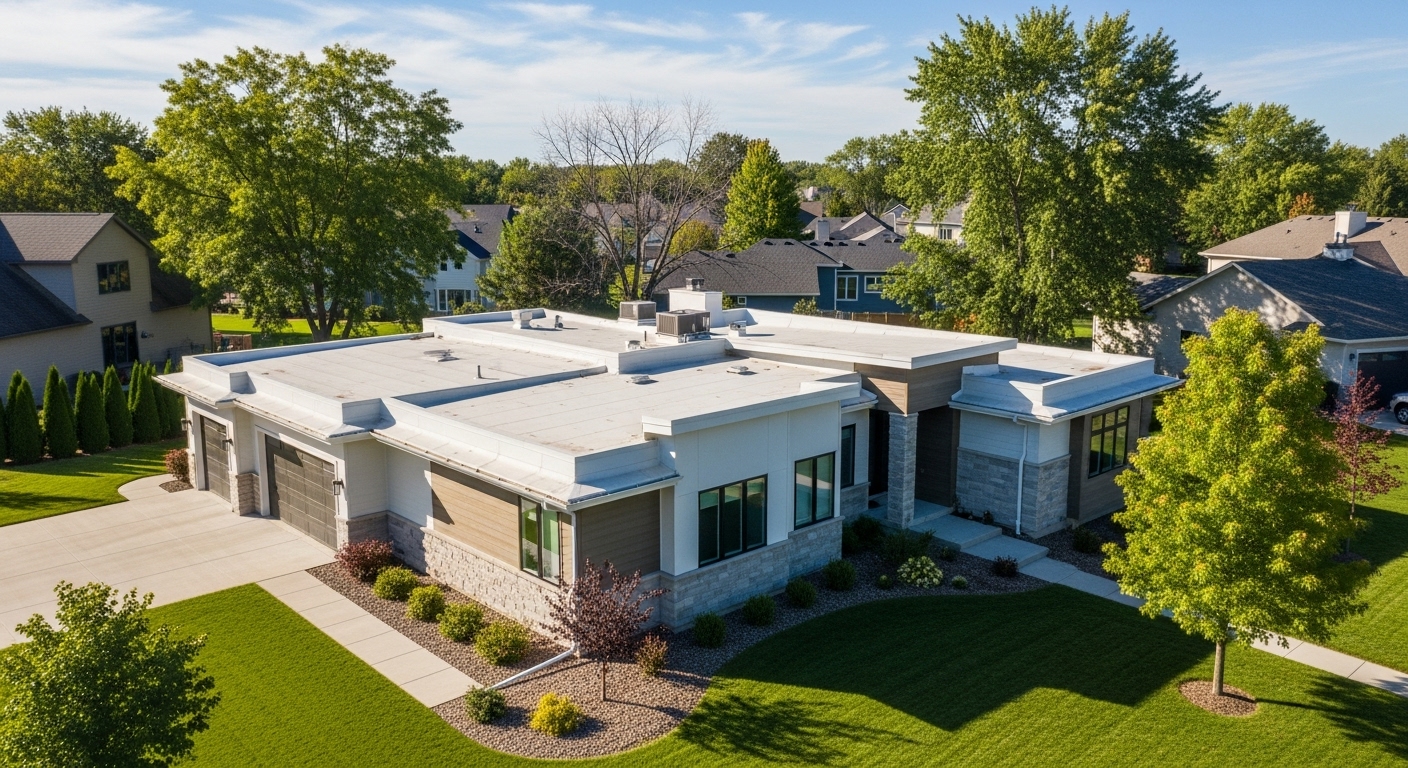
Short answer shows up fast. No, not in any normal, approved, or smart way. Longer answer takes more explaining, and that’s where most confusion sits. Homeowners see a flat white TPO roof and think, shingles are lighter than tile, so maybe this works. It usually does not. Roofing systems are picky like that.
TPO roofing and asphalt shingles live in very different worlds. Mixing them sounds efficient on paper, but roofs do not care about paper logic.
What TPO roofing actually is
TPO stands for thermoplastic polyolefin. It is a single ply roofing membrane, commonly used on flat or low slope roofs. Commercial buildings use it heavily, but plenty of residential homes have it too, especially modern designs or additions.
TPO gets heat welded at the seams. It relies on full adhesion or mechanical fastening over insulation boards. It sheds water by slope and membrane integrity, not by overlapping layers like shingles. That difference alone causes most problems.
Why asphalt shingles need a different foundation
In the United States, asphalt shingles are predominately fiberglass-based. Fiberglass-based asphalt shingles are manufactured with mat composed entirely of glass fibers of varying lengths and orientations. This fiberglass base is then surfaced with a specially formulated asphalt coating, followed by weather-resistant mineral granules. Organic-based asphalt shingles are manufactured with a base (also termed mat or substrate) made of various cellulose fibers, such as recycled waste paper and wood fibers. This organic base is then saturated with a specially formulated asphalt coating and surfaced with weather resistant mineral granules.
https://www.asphaltinstitute.org/engineering/asphalt-roofing/
Asphalt shingles are designed for sloped roofs. Most manufacturers require a minimum slope of 2 12, and many recommend steeper than that. Shingles rely on gravity, overlap, and airflow beneath them.
They are nailed through felt or synthetic underlayment into wood decking. That nailing pattern is not optional. Without solid decking underneath, shingles do not hold correctly, no matter how confident someone sounds while installing them.
The structural issue people overlook
TPO roofs are often installed over insulation boards, not plywood decking meant for nailing. Even when decking exists underneath, it may not be thick enough or properly fastened for shingle loads.
Adding shingles over TPO adds weight where the structure may not be rated for it. Asphalt shingles weigh roughly 200 to 300 pounds per square depending on type. Multiply that by 20 plus squares and the load adds up quickly. Roof framing feels that weight every day.
Moisture problems show up quietly
This is where things go bad slowly. TPO is a vapor barrier. Shingles need ventilation below them. Shingling over TPO traps moisture between systems. Condensation forms, plywood softens, fasteners loosen, and rot does not announce itself loudly.
By the time stains show inside, damage has already been paying rent for years.
Manufacturer warranties do not survive this idea
Asphalt shingle manufacturers are clear about approved substrates. TPO membranes are not on that list. Installing shingles over TPO voids warranties almost instantly. Same story from TPO manufacturers. Once penetrated by thousands of nails, the membrane no longer functions as designed.
If a contractor says warranty still applies, ask them to show it in writing. Silence usually follows.
Code compliance makes it worse
Building codes require roofing systems to follow manufacturer installation instructions. Since shingling over TPO violates those instructions, it also violates code in most jurisdictions. That can create issues during inspections, insurance claims, or resale.
Insurance adjusters notice these things. They always do when money is involved.
When removal is the only real option
If the goal is to switch from TPO to asphalt shingles, the correct method is full removal. That means tearing off the TPO membrane, removing insulation boards, inspecting decking, replacing damaged wood, and then rebuilding the roof assembly properly.
Yes, it costs more upfront. It also prevents paying twice later, which is the more common outcome with shortcuts.
Rare edge cases people talk about
Some will mention hybrid assemblies or specialty systems. These are usually engineered commercial setups, not residential roofing. They involve slope correction, structural redesign, and engineered fastening plans. They are not DIY friendly, and not cheap either.
For a typical house, those cases do not apply.
Cost comparison often drives the question
Homeowners ask about shingling over TPO because removal costs money. Tearing off TPO and insulation can add several thousand dollars to a project. But repairing trapped moisture, failed shingles, and rotten decking costs more, just spread out painfully over time.
Industry labor data shows roof replacements that skip proper tear off are more likely to need major repairs within 5 to 7 years. Proper rebuilds often last 20 years or more. That difference matters.
Final thoughts
Shingling over TPO sounds like efficiency. In practice, it is layering problems on top of each other and hoping gravity ignores physics. Roofing systems are designed as complete assemblies. Mixing them without redesigning the structure underneath leads to leaks, rot, and arguments later.
If the roof has TPO today and shingles are the goal tomorrow, removal is not optional. It is the cost of doing the job once instead of explaining later why it had to be done again.