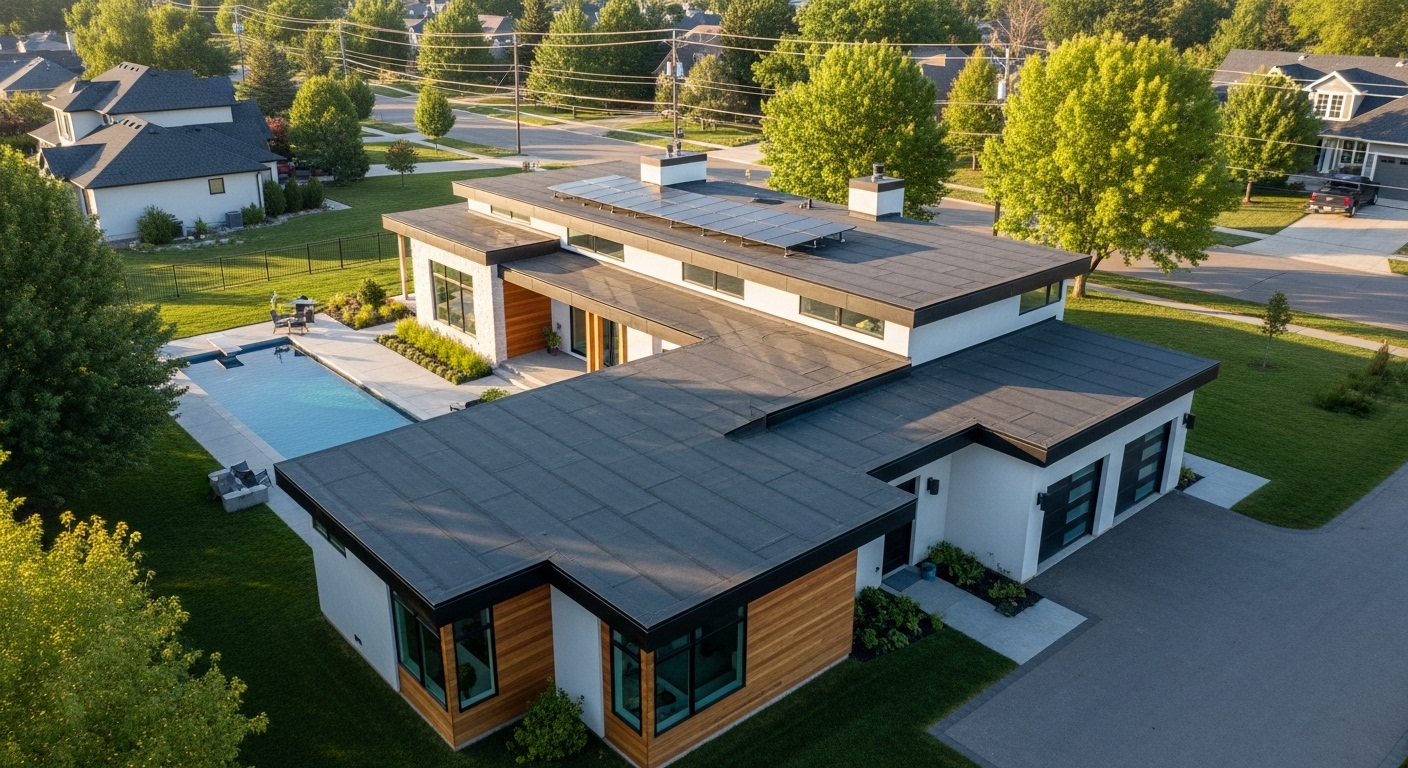
Flat and low slope roofs force decisions people don’t feel ready to make. Shingles are out, gravity is not helping much, and suddenly you are choosing between membranes that sound more like plumbing parts than roofs. PVC and EPDM get compared constantly because they solve the same problem but behave very differently once installed.
Most owners asking this are not shopping for theory. They want to know which one leaks less, lasts longer, costs more, and causes fewer regrets ten years down the road. Fair questions, slightly messy answers.
What PVC roofing actually is in plain terms
PVC roofing is a single ply membrane made from polyvinyl chloride. It comes in large rolls, heat welded at the seams, forming a continuous surface. The seams are fused using hot air, not glue, which matters more than brochures admit.
Short for polyvinyl chloride, PVC is a single-ply roofing membrane with excellent performance. EverGuard® PVC offers increased protection against chemicals1 and fire performance compared to other single ply roofing technologies, excellent seam strength, long-term weathering and UV resistance. Guarantees are available up to 30 years for qualified systems2.
https://www.gaf.com/en-us/roofing-materials/commercial-roofing-materials/pvc-membranes/resources
PVC membranes usually range from 45 to 80 mil thick. Thicker costs more but handles abuse better. The surface is typically white or light colored, designed to reflect sunlight and reduce heat buildup.
PVC has been around since the 1960s in roofing applications, though early versions had problems with plasticizer loss. Modern formulations fixed much of that, but not everyone trusts it equally.
What EPDM roofing is, and why it feels old school
EPDM is a synthetic rubber membrane, usually black, sometimes white. It has been used widely since the 1970s. The material is flexible, stretchy, and forgiving during installation. Sheets can be massive, reducing the number of seams.
A PVC roof consists of a single-ply membrane made from a blend of UV-resistant polyvinyl chloride, plasticizers, and stabilizers. It’s reinforced with polyester or fiberglass to increase durability and flexibility. This composition creates a roofing material that’s strong, yet flexible enough to withstand harsh weather conditions, building movement, and structural shifts.
https://www.quickroofing.com/blog/understanding-the-basic-of-pvc-roofing/
Seams in EPDM are usually glued or taped rather than welded. This makes installation simpler, but introduces long term dependency on adhesives staying stable year after year.
EPDM feels basic, almost boring. That boring nature is part of why many contractors still trust it.
Cost comparison, where the gap shows up first
Cost is often the deciding factor. EPDM is usually cheaper upfront. Installed costs for EPDM commonly fall between $4 and $7 per square foot depending on thickness and region. PVC typically runs higher, often between $6 and $10 per square foot installed.
That difference adds up quickly on larger commercial roofs. On smaller residential flat roofs, the gap may feel less dramatic but still noticeable.
PVC costs more partly due to material price and partly due to skilled labor required for heat welding seams. Not every crew does it well.
Installation differences that matter later
PVC installation relies heavily on seam welding quality. When done right, welded seams can be stronger than the membrane itself. When rushed or poorly trained, seams become the first failure point.
EPDM installation is more forgiving. Large sheets reduce seam count. Repairs are simpler, often involving cleaning and applying new tape or adhesive patches. This ease attracts contractors and building owners alike.
However, adhesives can degrade over time, especially under standing water or extreme heat cycles. Welded seams do not rely on chemical bonding in the same way.
Durability and lifespan expectations
Both systems can last 20 to 30 years when installed correctly and maintained. PVC has strong resistance to chemicals, grease, and oils, making it popular for restaurants and industrial buildings.
EPDM handles temperature swings exceptionally well. It expands and contracts without stressing seams as aggressively. This makes it reliable in colder climates with freeze thaw cycles.
Long term studies show EPDM roofs installed decades ago still performing well, which gives it credibility beyond marketing claims.
Heat, energy performance, and surface color realities
PVC is usually white, highly reflective, and classified as a cool roof. This can reduce rooftop temperatures significantly in hot climates. Some studies show surface temperatures dropping by 30 to 40 degrees compared to black membranes.
EPDM is traditionally black, absorbing heat. This can increase cooling loads in warm climates, though white EPDM options exist at higher cost.
In colder regions, heat absorption can actually be beneficial, reducing snow buildup and aiding drainage. Energy performance is climate dependent, not universal.
Puncture resistance and real world abuse
PVC membranes are generally tougher against grease and chemicals but can be less forgiving against sharp impacts depending on thickness. Thicker PVC improves this significantly.
EPDM’s rubber nature allows it to absorb impacts better without tearing. It stretches rather than cracks. This makes it resilient under foot traffic or minor debris.
Neither system enjoys careless rooftop behavior. Both benefit from walkway pads and basic respect.
Maintenance and repair over time
EPDM repairs are straightforward. Clean the area, apply primer, install patch. Many maintenance crews handle this without specialized equipment.
PVC repairs require heat welding, which means trained technicians and proper tools. That raises repair costs slightly but results in strong fixes when done right.
Routine inspections matter more than membrane choice. Most failures come from neglected drains, flashing issues, or rooftop equipment changes.
Environmental considerations people argue about
PVC has faced criticism for chlorine content and production concerns. Manufacturers have improved formulations and recycling programs, but debates remain.
EPDM is often viewed as more environmentally stable due to longevity and lower additive complexity. However, its black surface contributes to urban heat absorption.
Neither option is perfect. Both have tradeoffs that depend on values as much as performance.
Which one makes sense, and when
PVC tends to make sense for buildings exposed to grease, chemicals, or high heat loads. Restaurants, factories, and energy conscious designs lean this way.
EPDM works well for straightforward flat roofs, colder climates, and owners prioritizing lower upfront cost and easy repairs.
The right answer is rarely universal. It depends on climate, budget, building use, and who is installing it.
Final thoughts without sales language
PVC vs EPDM is not about better or worse in a vacuum. It is about risk tolerance, installer skill, and long term expectations. Both systems fail when installed poorly and perform well when respected.
Ask fewer questions about brand promises and more about who is doing the work, how seams are handled, and what maintenance will look like five years from now. Roofing decisions age with the building, not with the invoice.